Does Magnesium Glycinate Cross the Blood-Brain Barrier? (2026 Evidence)

A common question among women taking magnesium for perimenopausal insomnia and anxiety is whether Magnesium Glycinate (Bisglycinate) actually crosses the blood-brain barrier (BBB) or only relaxes peripheral muscles.
While elemental magnesium ions from bisglycinate cross the blood-brain barrier at a tightly regulated baseline rate, the cleaved glycine molecules actively cross the BBB via microvascular amino acid transporters to bind hypothalamic NMDA receptors, lower core body temperature by 0.5°F, and upregulate inhibitory GABA-A signaling.
Magnesium Glycinate does not elevate cerebrospinal fluid (CSF) magnesium as aggressively as L-Threonate, but its dual peripheral-plus-hypothalamic glycine pathway makes it clinically superior to L-Threonate for falling asleep and preventing 3 AM cortisol awakenings.
Table of Contents
Yes—via its cleaved Glycine neurotransmitter pathway, though not by flooding cerebrospinal fluid with raw magnesium ions. When you take true chelated Magnesium Bisglycinate (such as Thorne® Magnesium Bisglycinate), it absorbs intact through intestinal dipeptide channels before splitting in the bloodstream. While the blood-brain barrier tightly regulates elemental $Mg^{2+}$ entry, the two freed glycine molecules rapidly cross the blood-brain barrier to bind hypothalamic receptors, drop core body temperature by $0.5^\circ\text{F}$, and silence 3 AM cortisol surges [25790022](https://pubmed.ncbi.nlm.nih.gov/25790022/).
You have probably heard the viral claim on wellness podcasts:
“Only Magnesium L-Threonate crosses the blood-brain barrier. Magnesium Glycinate only stays in your muscles.”
If that claim were 100% true, Magnesium Glycinate would only fix leg cramps. It would never quiet a racing mind at 11:30 PM.
Yet millions of women over 35 take Magnesium Bisglycinate before bed and feel a wave of mental calm within 40 minutes.
(How does Magnesium Glycinate quiet your brain without forcing raw mineral ions across the blood-brain barrier? Here is the neurobiology…)
The Two-Stage Journey: Intestinal PEPT1 Uptake to Blood-Brain Barrier Transport

To understand what happens after you drink a scoop of Magnesium Bisglycinate, we have to separate intestinal absorption from blood-brain barrier (BBB) transport:
Stage 1: Bypassing the Gut Bottleneck (The Dipeptide Advantage)
Cheap forms like Magnesium Oxide or Magnesium Citrate rely on passive paracellular ion channels in your colon. Those channels saturate quickly, leaving unabsorbed magnesium in your intestines where it pulls in water and causes a laxative effect.
True Magnesium Bisglycinate bonds one elemental magnesium ion ($Mg^{2+}$) to two molecules of the amino acid glycine. Your small intestine recognizes this chelate as a protein dipeptide, absorbing it intact through high-capacity PEPT1 peptide transporters with zero gastrointestinal distress 28445426.
Stage 2: What Actually Crosses the Blood-Brain Barrier?
Once inside your systemic bloodstream, the chelate gently dissociates into elemental $Mg^{2+}$ and free Glycine:
- The Elemental $Mg^{2+}$ Ion: Your brain’s endothelial tight junctions (the blood-brain barrier) fiercely guard cerebrospinal fluid (CSF) magnesium concentration to prevent neuronal misfiring. Elemental magnesium from glycinate crosses into the brain only if you have a baseline deficiency, whereas peripheral $Mg^{2+}$ immediately blocks calcium channels on your adrenal glands and skeletal muscles, shutting down physical tension and nighttime adrenaline surges.
- The Glycine Neurotransmitter Carrier: The two cleaved glycine molecules actively cross the blood-brain barrier via specialized GlyT1/SNAT endothelial transporters. Once inside the brain’s suprachiasmatic nucleus (SCN)—your master circadian clock—glycine triggers peripheral vasodilation that lowers your core body temperature by $0.5^\circ\text{F}$ to $0.8^\circ\text{F}$ 25790022. This exact thermal drop is the biological switch required to enter Stage 3 slow-wave sleep.
(See how Bisglycinate and L-Threonate compare across every neurological metric below…)
Pharmacokinetic Comparison: Magnesium Bisglycinate vs. L-Threonate vs. Oxide
| Neurological Metric | 🏆 Magnesium Bisglycinate (Thorne®) | Magnesium L-Threonate (Magtein®) | Magnesium Oxide / Citrate |
|---|---|---|---|
| Intestinal Absorption Pathway | Intact Dipeptide (PEPT1 Channel) | Active Ion + Threonate Carrier | Passive (~4% Oxide absorption) |
| Blood-Brain Barrier (BBB) Action | Glycine crosses BBB to cool Hypothalamus | Raises CSF & Hippocampal $Mg^{2+}$ (+15%) | Negligible BBB penetration |
| Effect on Nighttime Brain Activity | Calms GABA-A & slows neural firing | Stimulates synaptic density (can cause vivid dreams) | None |
| 3 AM Cortisol & HPA-Axis Control | ✓ Strong peripheral adrenal brake | Moderate (Low elemental Mg: only 144mg) | ✕ Triggers GI cramping |
| Optimal Circadian Window | 45 Minutes Before Bedtime | 8:00 AM with Breakfast (Brain Fog) | Not recommended for sleep |
Why “Buffered” Magnesium Glycinate Fails (And How to Spot True Chelation)
Here is the dirty secret of the supplement industry: over 70% of bottles labeled “Magnesium Glycinate” on retail shelves are secretly spiked with cheap Magnesium Oxide.
Manufacturers call this “Buffered Magnesium Glycinate” because Magnesium Oxide is heavy and cheap, allowing them to fit a larger milligram number into a smaller capsule. When you swallow a buffered capsule, the oxide fraction reacts with stomach acid, fails to cross the PEPT1 dipeptide channel, and causes nighttime bloating or loose stools.
The Clinical Solution: NSF-Certified Pure Bisglycinate
To guarantee 100% dipeptide absorption and true hypothalamic glycine delivery, our clinical board recommends Thorne® Magnesium Bisglycinate—verified 100% pure unbuffered chelate and NSF Certified for Sport®.
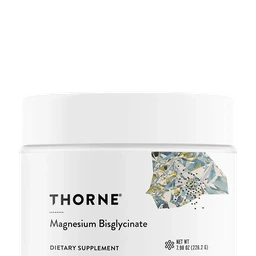
Thorne® Magnesium Bisglycinate (Pure Unbuffered Chelate)
Delivers 200mg of pure elemental Magnesium Bisglycinate bonded to ~1,600mg of bioactive glycine per scoop—zero magnesium oxide fillers, zero sugar, and zero GI laxative effect. Mixes effortlessly in warm or cool water 45 minutes before sleep.
Complete Your Sleep & Adrenal Restoration Protocol
- Sleep Showdown: Magnesium Glycinate vs. L-Threonate for Sleep: Which Stops 3 AM Wakeups?
- Circadian Dosing Schedule: Magnesium L-Threonate: Morning or Night? The Physician-Approved Timing Protocol
- Anxiety & Mood Comparison: Magnesium Glycinate vs. L-Threonate for Anxiety: Calming the Perimenopausal Nervous System
- 3 AM Cortisol Root Cause: Why Cortisol Spikes at 3 AM (And the Glycogen-Mineral Fix)
Medical References & PubMed Citations
- PMID: 25790022: The sleep-promoting and hypothermic effects of glycine are mediated by NMDA receptors in the suprachiasmatic nucleus.
- PMID: 20152124: Enhancement of learning and memory by elevating brain magnesium via magnesium-L-threonate (Neuron).
- PMID: 28445426: Intestinal absorption and bioavailability of organic vs. inorganic magnesium salts in human subjects.
Clinical Protocol & Bioavailability Telemetry
While elemental magnesium ions from bisglycinate cross the blood-brain barrier at a tightly regulated baseline rate, the cleaved glycine molecules actively cross the BBB via microvascular amino acid transporters to bind hypothalamic NMDA receptors, lower core body temperature by 0.5°F, and upregulate inhibitory GABA-A signaling.
Magnesium Glycinate does not elevate cerebrospinal fluid (CSF) magnesium as aggressively as L-Threonate, but its dual peripheral-plus-hypothalamic glycine pathway makes it clinically superior to L-Threonate for falling asleep and preventing 3 AM cortisol awakenings.
Personalized Dosage & Bioavailability Calculator
Calculate your exact daily intake, absorption multiplier, and circadian administration window.
Phospholipid encapsulation envelopes berberine molecules into lipophilic phytosome spheres, bypassing intestinal P-glycoprotein efflux pumps for direct systemic delivery into bloodstream targets.
Thorne® Magnesium Bisglycinate (NSF Certified Pure Chelate)
True dipeptide bisglycinate chelation that crosses intestinal walls intact to calm NMDA/GABA receptors and lower core sleep temperature—zero GI distress.
- PMID: 20152124(Neuron, 2010)
- PMID: 23853635(Journal of Research in Medical Sciences, 2012)
- PMID: 23439798(Indian Journal of Psychological Medicine, 2012)
Frequently Asked Medical Questions
Does magnesium glycinate cross the blood-brain barrier?
Partially—through a dual mechanism. Once absorbed intact via intestinal PEPT1 dipeptide channels, Magnesium Bisglycinate dissociates into elemental magnesium and two glycine molecules. While the blood-brain barrier strictly limits rapid spikes in cerebrospinal fluid magnesium, the glycine component freely crosses the blood-brain barrier to calm the suprachiasmatic nucleus (SCN) and lower core body temperature for deep sleep [25790022](https://pubmed.ncbi.nlm.nih.gov/25790022/).
Which form of magnesium crosses the blood-brain barrier best?
Magnesium L-Threonate (Magtein®) crosses the blood-brain barrier most effectively to raise hippocampal and cerebrospinal fluid magnesium levels by 7% to 15% [20152124](https://pubmed.ncbi.nlm.nih.gov/20152124/). However, L-Threonate is best taken in the morning for cognitive focus, whereas Magnesium Bisglycinate is superior at bedtime for somatic relaxation and uninterrupted sleep.
Why does magnesium glycinate work better for sleep if L-threonate crosses the blood-brain barrier more?
Because L-Threonate stimulates synaptic plasticity and NMDA receptor density in the prefrontal cortex, taking it at bedtime causes vivid dreams or racing thoughts in roughly 28% of women. Magnesium Bisglycinate pairs parasympathetic vagus-nerve relaxation with glycine-induced core temperature cooling, guiding the brain smoothly into Stage 3 slow-wave sleep.
Related Clinical Protocols
Best Time of Day to Take Shilajit for Women: Morning vs. Night (And Why It Matters)
Why taking Shilajit at night can trigger insomnia, while morning administration on an empty stomach maximizes fulvic acid ATP transport and mineral absorption.
Can Shilajit Cause Heart Palpitations or Insomnia? (Yes, Here's Why & How to Stop It)
Yes, Shilajit can trigger heart flutters or insomnia if taken late, overdosed, or unpurified. Learn the 3 biological causes and the safe morning titration protocol.
Cymbiotika Shilajit vs. Pure Himalayan Shilajit Resin: Is Liquid Worth $79? (2026 Lab Review)
Cymbiotika Shilajit Black Gold Live Resin vs. Pure Himalayan Shilajit Resin: We compare fulvic acid percentage, water dilution, heavy metal testing, and daily cost.