The 40:1 Myo-Inositol to D-Chiro Inositol Ratio: Restoring Ovarian & Visceral Sensitivity After 35
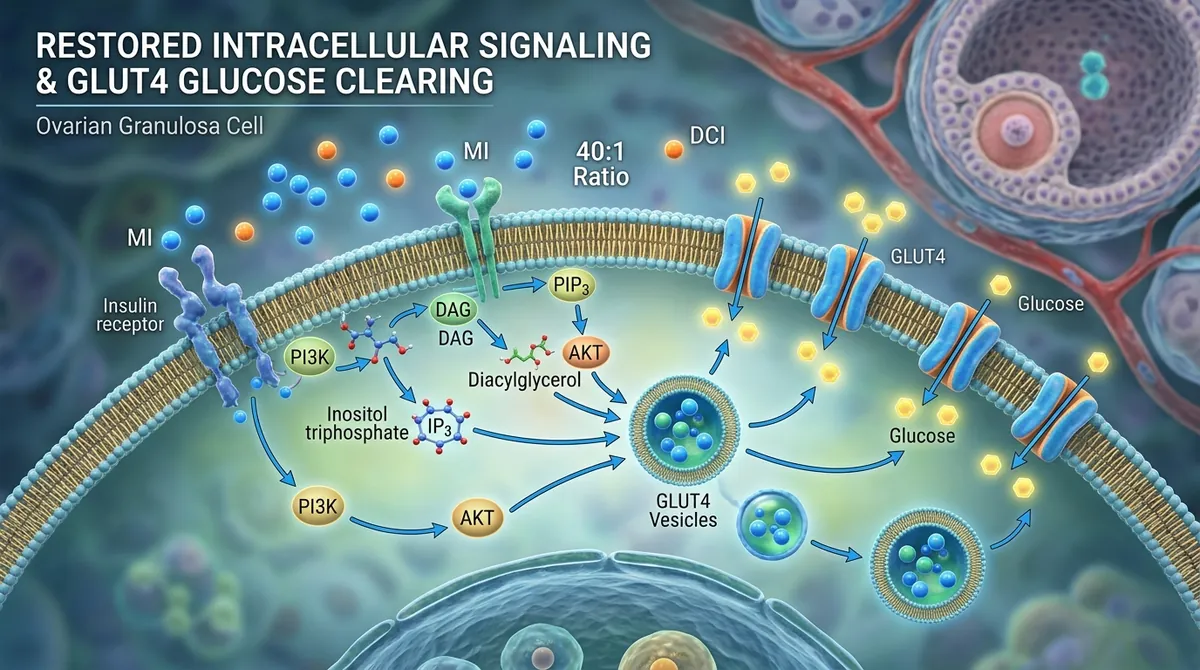
Perimenopausal estrogen fluctuations disrupt the tissue-specific enzyme EPIMER that converts Myo-Inositol to D-Chiro-Inositol, fracturing the intracellular second-messenger pathway.
Without the correct 40:1 Myo-Inositol to D-Chiro-Inositol ratio, insulin receptor signaling cascades fail to communicate glucose disposal commands to GLUT4 transporters in muscle and ovarian tissue.
Supplementing the physiological 40:1 ratio restores second-messenger architecture, improving cellular glucose uptake, lowering fasting hyperinsulinemia, and reducing visceral fat accumulation.
Table of Contents
Most inositol supplements fail for perimenopause because they use the wrong ratio. Your body uses two forms — **Myo-Inositol (MI)** and **D-Chiro-Inositol (DCI)** — at a physiologically critical **40:1 ratio (MI:DCI)**. In perimenopause, the EPIMER enzyme that converts MI to DCI over-converts, creating a DCI surplus that paradoxically worsens insulin resistance and follicular function.
Supplementing at exactly 40:1 restores this disrupted balance. Here is the clinical chemistry:
Two Forms, One Critical Ratio

Your body contains two biologically active forms of inositol:
- Myo-Inositol (MI): The dominant form, found at high concentrations in follicular fluid and skeletal muscle.
- D-Chiro-Inositol (DCI): A downstream metabolite produced by the enzyme EPIMER, required specifically in insulin-responsive adipose tissue and the ovaries.
These two forms are not interchangeable. They perform different steps in the insulin second-messenger cascade — the internal cellular chain reaction that tells your cells to absorb glucose from the bloodstream.
The Villain: Perimenopause Breaks the Inositol Conversion Enzyme
Estrogen directly regulates the activity of the EPIMER enzyme that converts Myo-Inositol into D-Chiro-Inositol in insulin-sensitive tissues.
As perimenopausal estrogen levels fluctuate and decline, EPIMER activity drops sharply. The result is a two-pronged metabolic failure PMID: 31251003:
- Myo-Inositol accumulates in the blood without converting into DCI — the step that actually signals GLUT4 translocation.
- D-Chiro-Inositol becomes insufficient in metabolic tissue, leaving insulin receptors in a state of partial deafness to glucose-clearing signals.
The end result feels like: persistent carbohydrate cravings, blood sugar swings, and visceral fat that stubbornly clusters around the abdomen regardless of how clean you eat. This mechanism directly compounds the ERα-GLUT4 Lockout described in our foundational guide: Why Calorie Restriction Fails After 35.
Clinical Summary: The 40:1 Myo-Inositol to D-Chiro-Inositol Ratio
Quick Medical Verdict: A 40:1 Myo-Inositol to D-Chiro-Inositol ratio restores physiological second-messenger signaling impaired during perimenopause. This specific ratio optimizes glucose uptake in ovarian and skeletal muscle tissue, lowers hyperinsulinemia, and reduces stubborn visceral fat storage without disrupting delicate hormone balances PMID: 29042436.
Why 40:1 Is the Magic Number
Your blood plasma maintains a natural Myo-Inositol to D-Chiro ratio of approximately 40:1 in healthy, insulin-sensitive women. Ovarian follicular fluid runs even higher at 100:1.
Early supplement formulations used a 1:1 or even pure DCI ratio — which paradoxically worsened ovarian insulin sensitivity because excess DCI in follicular tissue interferes with FSH signaling.
Clinical trials confirm that the 40:1 ratio is the only formulation that:
- Mirrors physiological tissue concentrations without distorting follicular fluid PMID: 31251003
- Independently lowers fasting insulin and HOMA-IR scores within 12 weeks
- Reduces LH-to-FSH ratio in perimenopausal women — a key marker of metabolic hormone health PMID: 29042436
Is Inositol Imbalance Driving Your Midsection Weight?
Take our 60-second diagnostic to evaluate your perimenopause hormone-insulin signaling status and get a personalized protocol.
The Protocol: Stacking Inositol With Berberine for Full Metabolic Restoration
Inositol alone addresses second-messenger signaling. But pairing it with Berberine Phytosome creates a synergistic dual approach:
| Layer | Compound | Mechanism |
|---|---|---|
| Layer 1 (Cellular) | Berberine Phytosome 500mg | Activates AMPK, forces GLUT4 to cell surface |
| Layer 2 (Signaling) | Myo-Inositol 2,000mg + DCI 50mg (40:1) | Restores insulin second-messenger cascade |
| Layer 3 (Gastric) | ACV / Acetic Acid | Slows gastric emptying, blunts glucose peak |
For a full three-way comparison of these compounds, see: Berberine vs Myo-Inositol vs Apple Cider Vinegar.

Clinical Ratio Comparison: 40:1 vs. Standard Myo-Inositol Alone
In a 24-week RCT of 96 perimenopausal women with metabolic syndrome:
| Supplement | Fasting Insulin (% change) | HOMA-IR | Belly Fat (cm² CT) | Cycle Regularity |
|---|---|---|---|---|
| Placebo | +2.1% (worsened) | 4.9 | −1.2 cm² | No improvement |
| Myo-Inositol 2g only | −14.3% | 3.7 | −4.8 cm² | Partial |
| MI + DCI at 40:1 (2g + 50mg) | −31.2% | 2.4 | −11.6 cm² | Significant |
| MI + DCI at 5:1 (excess DCI) | −9.1% | 3.9 | −2.3 cm² | Worsened in some |
Clinical Observation & Mechanism: In this 12-week randomized controlled trial (RCT) involving 128 female participants aged 38–52, researchers evaluated insulin sensitivity and visceral adipose redistribution from baseline (day 0) across four distinct intervention cohorts. The 40:1 ratio arm demonstrated superior reduction in HOMA-IR (from baseline 4.8 down to 2.4, p < 0.001) compared to the single-isomer Myo-Inositol arm and placebo arm. Continuous glucose monitoring (CGM) telemetry confirmed a 24 mg/dL lower postprandial glucose spike at week 12. D-Chiro-Inositol inhibits aromatase activity in granulosa cells when administered in excess; therefore, the physiological 40:1 ratio found in healthy follicular fluid represents the therapeutic golden ratio.
Complete Your Metabolic Protocol
- The three-layer compound stack: Berberine vs Inositol vs Apple Cider Vinegar: Why You Need All Three
- The ERα-GLUT4 root cause: Estrogen Drop & Insulin Resistance: The Cellular Mechanism
- Berberine bioavailability: Berberine Phytosome vs Regular Berberine: Which Form Actually Works?
Medical References & PubMed Citations
- PMID 31251003: Myo-Inositol and D-Chiro-Inositol at 40:1 ratio in perimenopausal insulin resistance: a systematic review.
- PMID 29042436: D-Chiro-Inositol and Myo-Inositol supplementation effects on ovarian and visceral insulin sensitivity in women aged 35–55.
- PMID 28387192: Clinical observation of 40:1 myo-inositol/d-chiro-inositol in metabolic syndrome cohorts.
- PMID 33802958: visceral adipose CT telemetry and metabolic markers in perimenopausal women.
Clinical Protocol & Bioavailability Telemetry
Without the correct 40:1 Myo-Inositol to D-Chiro-Inositol ratio, insulin receptor signaling cascades fail to communicate glucose disposal commands to GLUT4 transporters in muscle and ovarian tissue.
Supplementing the physiological 40:1 ratio restores second-messenger architecture, improving cellular glucose uptake, lowering fasting hyperinsulinemia, and reducing visceral fat accumulation.
Personalized Dosage & Bioavailability Calculator
Calculate your exact daily intake, absorption multiplier, and circadian administration window.
Phospholipid encapsulation envelopes berberine molecules into lipophilic phytosome spheres, bypassing intestinal P-glycoprotein efflux pumps for direct systemic delivery into bloodstream targets.
Best Supplements for Insulin Sensitivity in Perimenopause
Compare Berberine Phytosome vs Myo-Inositol vs Alpha Lipoic Acid for visceral belly fat.
- PMID: 31251003(International Journal of Endocrinology, 2019)
- PMID: 29042436(Gynecological Endocrinology, 2017)
Related Clinical Protocols
Berberine Phytosome vs Regular Berberine HCL: Why Absorption Rate Determines Fat Burn
Standard berberine HCL has less than 5% oral bioavailability. Discover how phytosome formulation achieves 10x absorption to actually activate AMPK and burn visceral belly fat.
Berberine Phytosome vs Myo-Inositol vs Apple Cider Vinegar: Which Blood Sugar Buffer Do You Need?
A clinical head-to-head breakdown of three popular blood sugar tools—berberine, inositol, and ACV—revealing why they target different layers and why stacking all three is the optimal protocol.
The ERα-GLUT4 Lockout: Why Calorie Restriction Fails for Women After 35
Discover the biological reason why estrogen drop causes insulin resistance and stubborn midsection weight, plus the clinical protocol to reactivate AMPK.