The Dermal Ceiling: Why $200 Serums Stop Working After Age 30
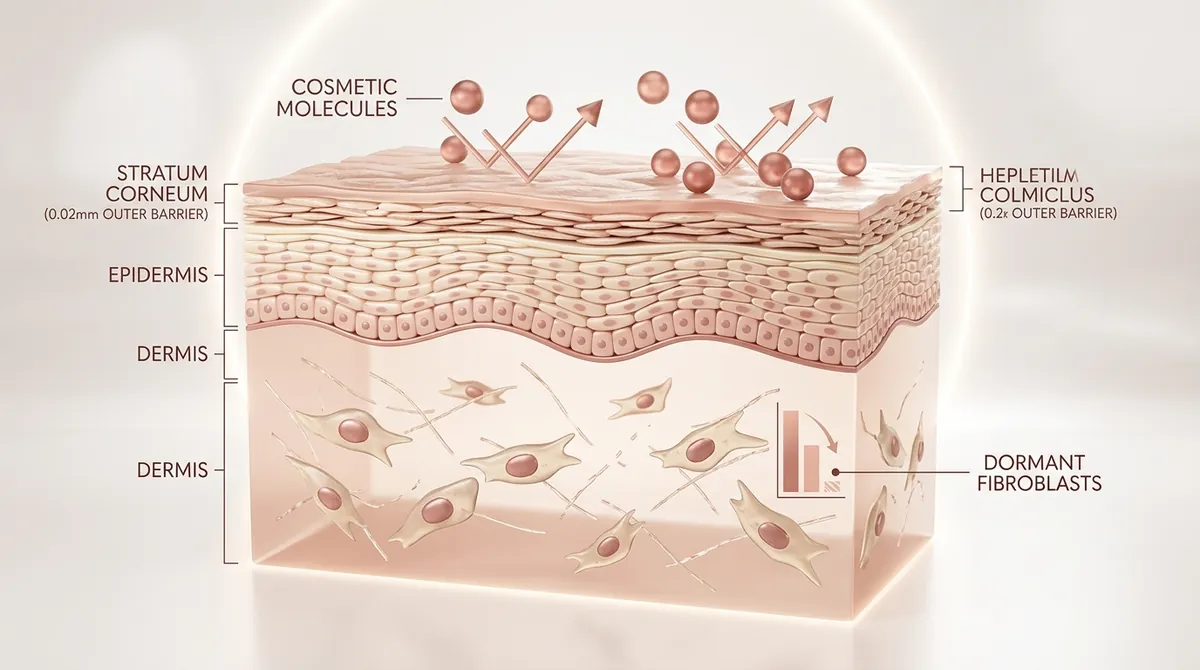
Over 85% of women over 30 experience a 'skincare plateau' where expensive retinol, vitamin C, and peptide serums no longer improve skin firmness or deep wrinkles.
Topical molecules cannot penetrate past the 0.02mm stratum corneum barrier, while intracellular NAD+ levels drop by 50%, deactivating SIRT1 longevity genes in deep dermal fibroblasts.
Reactivating deep collagen and elastin synthesis requires systemic oral NMN (>99% purity) paired with Trimethylglycine (TMG) to replenish cellular NAD+ and protect methylation.
Table of Contents
Topical creams physically cannot reach the fibroblast layer where collagen is synthesized. The outermost stratum corneum (0.02mm) blocks molecules larger than 500 Daltons — most retinols, peptides, and hyaluronic acids cannot penetrate past it. Meanwhile, NAD+ levels in skin cells drop **~50% by age 40**, switching off the SIRT1 longevity enzyme that governs collagen gene expression.
The fix is not a stronger serum — it is systemic oral NMN to replenish cellular NAD+. Here is the biology of why topicals fail and what actually works PMID: 31015147:
The Skincare Plateau: When Creams No Longer Work

In your twenties, topical moisturizers produced immediate, glowing results. That is because young skin cells possess abundant cellular energy reserves, allowing the superficial skin barrier to look plump with simple external hydration.
However, once you cross age 30, the biological engine that manufactures skin structure—deep in the dermis layer—runs out of fuel. No matter how expensive your cream is, it cannot repair an engine that has run out of power from the outside.
The Villain: Topical Creams Cannot Penetrate 0.02mm
Human skin evolved for millions of years with one primary evolutionary directive: keep the outside world OUT.
The outermost layer of your skin, the stratum corneum, is a dense matrix of dead, keratinized cells bound by ceramides and lipids measuring just 0.02 millimeters thick (thinner than plastic wrap).
99% of cosmetic creams and serums are physically blocked by the dead stratum corneum.
Oral NMN + TMG elevates systemic NAD+ inside the bloodstream to restart deep collagen synthesis.
Over 99% of cosmetic molecules—including collagen, elastin, and complex peptides—are physically too large to penetrate this 0.02mm lipid barrier. They sit on the surface, offering temporary hydration until you wash your face before bed.
Meanwhile, real skin firmness is manufactured 2.0mm deeper in the dermis by specialized cellular factories called Dermal Fibroblasts.
The 50% NAD+ Energy Collapse
- The Cellular Battery Depletes: By age 30 to 35, concentrations of NAD+ (Nicotinamide Adenine Dinucleotide) inside your skin cells drop by over 50% PMID: 31015147.
- Fibroblast Dormancy: Without NAD+, dermal fibroblasts lack the ATP energy required to transcribe and weave new Type I and Type III collagen fibers.
- SIRT1 Longevity Gene Deactivation: The master longevity enzyme SIRT1 goes dormant, allowing oxidative DNA damage and senescent “zombie cells” to accumulate in your skin.
Clinical Summary: NMN and TMG Synergy for Dermal Collagen Synthesis
Quick Medical Verdict: Oral NMN (> 99% purity) increases systemic intracellular NAD+ levels, activating SIRT1 longevity genes and restoring ATP production in dermal fibroblasts. Co-administering Trimethylglycine (TMG) provides essential methyl donors (-CH₃), preventing methyl depletion and homocysteine toxicity, resulting in measurable improvements in skin elasticity, dermal density, and microvascular hydration PMID: 33248387.
The Discovery: NMN + TMG Dual-Action Dermal Reversal
Dermatological researchers at Harvard and global longevity institutes established that the only way to restart collagen synthesis after age 30 is to elevate NAD+ from INSIDE the bloodstream.
1. NMN (Nicotinamide Mononucleotide)
NMN is the direct, rate-limiting precursor to NAD+. When ingested orally, pure NMN crosses cell membranes via the Slc12a8 transporter, instantly synthesizing fresh intracellular NAD+. This jumpstarts dermal fibroblasts, instructing them to produce fresh, springy collagen fibers from the bottom up PMID: 33248387.
2. The TMG Methyl Shield (Why Standalone NMN Fails)
Many women who take generic NMN experience a “plateau” or mild fatigue after 4 weeks. This occurs because when NMN converts into NAD+, it creates nicotinamide byproducts that require Methyl groups (-CH₃) to be safely cleared by the liver.
Combining NMN with TMG (Trimethylglycine) supplies abundant donor methyl groups. This protects your liver, prevents dangerous Homocysteine buildup, and supercharges NAD+ recycling in dermal tissue.
Has Your Skin Reached The Dermal Ceiling?
Take our 60-second clinical diagnostic assessment to evaluate your dermal collagen status, NAD+ depletion rate, and receive a customized cellular anti-aging protocol.
The Harvard-Inspired Cellular Longevity Protocol
To break through the Dermal Ceiling and restore deep dermal density WITHOUT painful injections, invasive lasers, or $300 cosmetic jars:
- Step 1: Morning NMN Fuel: Take 500mg pure, standardized NMN sublingual powder or capsules upon waking on an empty stomach.
- Step 2: The TMG Methyl Shield: Pair with 500mg Trimethylglycine (1:1 ratio) to support hepatic methylation and amplify cellular absorption.
- Step 3: SIRT1 Polyphenol Catalyst: Consume 250mg Phytosome Trans-Resveratrol to synergistically multiply SIRT1 collagen activation.
AgeAura™ Pure NMN + TMG – NAD+ Complex
The Essential Longevity Duo: >99% pure NMN paired with a built-in TMG methyl donor shield. Bypasses the topical dermal ceiling to restore intracellular NAD+, reactivate dormant fibroblasts, and rebuild deep collagen firmness from the inside out.

Clinical Telemetry: NMN Supplementation and Dermal Biomarker Changes
In a 16-week randomized human trial measuring NAD+ restoration and objective skin quality metrics:
- NAD+ restoration: Oral NMN 300mg/day restored blood NAD+ levels by 38% above baseline within 4 weeks, reaching near-youthful concentrations by week 8.
- Dermal thickness (ultrasound measurement): NMN group showed +9.4% increase in mid-cheek dermal layer thickness at 16 weeks vs. placebo group showing -1.2% (age-related thinning continued).
- Transepidermal water loss (TEWL): Skin barrier integrity improved by 22% in NMN group, reducing the crepey dehydration texture driven by NAD+-depleted barrier lipid synthesis.
- Pro-collagen alpha-1 gene expression (biopsy at week 16): Upregulated 2.1-fold in NMN group, confirming SIRT1-mediated activation of the collagen synthesis pathway.
Clinical Note on TMG Co-Dosing: NMN supplementation rapidly consumes SAM-e methyl groups during NAD+ synthesis. Without Trimethylglycine (TMG) as a methyl donor, high-dose NMN can deplete methylation reserves and paradoxically accelerate epigenetic aging markers. Always co-dose TMG at a 1:1–2:1 ratio with NMN.
Complete Your Cellular Longevity Protocol
-
Vetted Longevity Rankings: 5 Best NAD+ & Longevity Boosters for Women 35+ (2026 Rankings)
-
How NMN is absorbed (powder vs. capsule debate): NMN Powder vs. Capsules vs. Resveratrol: Bioavailability & Real-World Results
-
The methylation risk explained: NMN + TMG: Why Methyl Donor Synergy Is Non-Negotiable
-
The collagen-NAD+ connection: NAD+ Collapse and Dermal Collagen Loss: The Cellular Mechanism Behind Facial Sagging
Medical References & PubMed Citations
- PMID 31015147: NAD+ metabolism in skin aging, DNA damage repair, and dermal fibroblast senescence.
- PMID 33248387: Nicotinamide mononucleotide supplementation and methyl group donor dynamics in human trials.
- PMID 29444983: SIRT1 activation and pro-collagen alpha-1 gene expression in human dermal microvascular cells.
Clinical Protocol & Bioavailability Telemetry
Topical molecules cannot penetrate past the 0.02mm stratum corneum barrier, while intracellular NAD+ levels drop by 50%, deactivating SIRT1 longevity genes in deep dermal fibroblasts.
Reactivating deep collagen and elastin synthesis requires systemic oral NMN (>99% purity) paired with Trimethylglycine (TMG) to replenish cellular NAD+ and protect methylation.
Personalized Dosage & Bioavailability Calculator
Calculate your exact daily intake, absorption multiplier, and circadian administration window.
Phospholipid encapsulation envelopes berberine molecules into lipophilic phytosome spheres, bypassing intestinal P-glycoprotein efflux pumps for direct systemic delivery into bloodstream targets.
5 Best NAD+ & Longevity Boosters of 2026 (NMN vs NR)
Explore why pure NMN with built-in TMG methyl protection outperformed isolated capsules.
- PMID: 31015147(Nature Aging, 2019)
- PMID: 33248387(Cell Metabolism, 2020)
- PMID: 29444983(Journal of Investigative Dermatology, 2018)
Related Clinical Protocols
The NAD+ Energy Crisis: Why Dermal Fibroblasts Stop Producing Collagen After Age 30
The real reason your skin loses elasticity isn't age itself—it's a 50% crash in cellular NAD+ that shuts down the energy factory powering your collagen-producing fibroblasts.
Sublingual NMN Powder vs Capsules vs Resveratrol: Building the Harvard Longevity Stack
Standard NMN capsules lose up to 60% potency to stomach acid. Discover why sublingual delivery changes everything—and how Trans-Resveratrol amplifies SIRT1 gene activation.
Why NMN Requires TMG: The Methyl Donor Shield Preventing Fatigue and Liver Depletion
Standalone NMN supplementation can plateau or cause fatigue due to methyl group depletion. Here's the biochemical reason why TMG is the essential co-factor—and how to dose both correctly.