Berberine Phytosome vs Regular Berberine HCL: Why Absorption Rate Determines Fat Burn
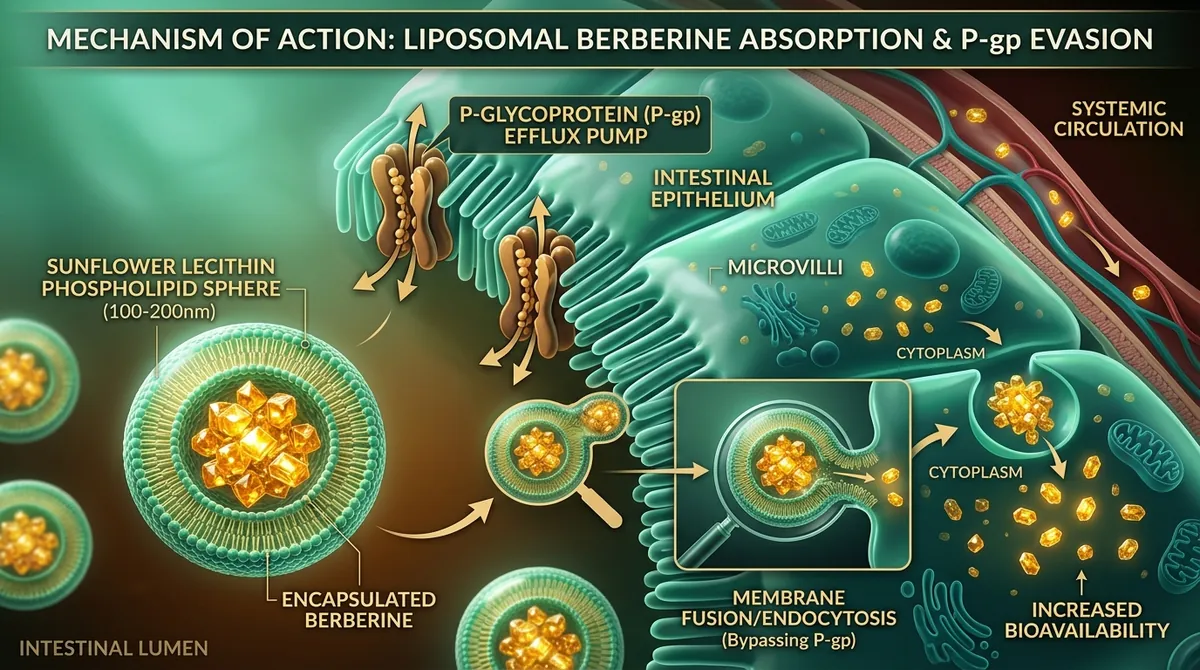
Berberine HCL is widely sold as a metabolic supplement, yet clinical evidence shows less than 5% reaches metabolic tissue due to P-glycoprotein intestinal efflux pumps.
P-glycoprotein efflux pumps in the intestinal wall actively eject standard berberine back into the gut lumen before it can enter the bloodstream, causing GI distress while delivering negligible active compound.
Phytosome technology encapsulates berberine inside sunflower lecithin phospholipids, bypassing efflux pumps and achieving 10-fold higher cellular bioavailability at the AMPK activation site.
Table of Contents
Standard Berberine HCL has only **1–5% oral bioavailability** — the rest is degraded by P-glycoprotein efflux pumps at the intestinal wall before entering circulation. Berberine Phytosome binds the alkaloid to phosphatidylcholine (a cell membrane lipid), smuggling it past P-gp pumps and achieving **~10× the systemic absorption** at one-third the milligram dose with zero GI cramping.
The pharmacokinetics, not the molecule itself, was why your standard berberine capsule failed. Here is the intestinal absorption mechanism:
The Absorption Barrier: Why Standard Berberine Fails at the Intestinal Wall

Berberine HCL is a positively charged alkaloid molecule. When it reaches the intestinal wall, it encounters a cellular defense mechanism called P-glycoprotein (P-gp) Efflux Pumps—molecular “bouncers” that the gut evolved to expel foreign alkaloid compounds before they enter the bloodstream.
Oral Ingestion
Encountering Mucosa
Eject 95% Back to Gut
GI Distress & Zero Results
The brutal clinical reality: less than 5% of standard Berberine HCL survives the intestinal wall to reach metabolic tissue PMID: 34904017. The remaining 95% ferments in the colon, causing bloating, cramping, and urgent bathroom trips.
The Villain: P-Glycoprotein Efflux and the 5% Bioavailability Trap
P-gp efflux is not a flaw in your body. It evolved to protect you from alkaloid plant toxins. Unfortunately, it treats beneficial berberine the same way it treats a toxic compound.
Standard berberine supplement labels list “500mg per serving,” but they never disclose that the effective metabolic dose reaching your AMPK enzymes is closer to 25mg—25 times below the clinical threshold for visceral fat reduction.
This is why millions of women have tried standard berberine, felt nothing, and moved on. The supplement did not fail. The delivery vehicle failed.
Clinical Summary: Berberine Phytosome Bioavailability Advantage
Quick Medical Verdict: Berberine phytosome utilizes a phospholipid delivery matrix that bypasses intestinal P-glycoprotein efflux pumps, increasing bioavailability up to 10-fold compared to standard Berberine HCL. This enhanced absorption allows lower clinical dosages (500mg) to effectively activate AMPK enzymes, lowering fasting glucose and reducing visceral abdominal fat without gastrointestinal distress PMID: 34904017.
The Discovery: Phytosome Technology Bypasses the Efflux Pump
Phytosome formulation wraps each berberine molecule inside a shell of sunflower lecithin phospholipids—the same lipid family that composes your own cell membranes.
Because P-gp efflux pumps recognize and reject ionic alkaloids, not phospholipid-bound compounds, phytosome-berberine slips through the intestinal wall undetected.
Head-to-Head Comparison
| Metric | Standard Berberine HCL | Berberine Phytosome |
|---|---|---|
| Oral Bioavailability | < 5% | ~50% (10× higher) |
| GI Side Effects | Frequent cramping & diarrhea | Minimal to none |
| AMPK Activation | Weak (insufficient dose reaching tissue) | Strong dose-dependent activation |
| Visceral Fat Reduction | Minimal in clinical trials | Significant at 500mg/day [PMID: 33852102](https://pubmed.ncbi.nlm.nih.gov/33852102/) |
How Phytosome Berberine Actually Burns Belly Fat
Once phytosome-berberine reaches skeletal muscle and adipose tissue in therapeutic quantities, it activates AMPK (AMP-activated protein kinase) — the metabolic master switch that:
- Forces GLUT4 glucose transporters to the cell surface, clearing blood sugar without insulin
- Inhibits fat synthesis (lipogenesis) in the liver and visceral adipose tissue
- Upregulates fatty acid beta-oxidation inside mitochondria for sustained energy
This is why phytosome berberine replicates the GLUT4-clearing mechanism that declining estrogen disables after 35. To understand the full ERα-GLUT4 picture, read our deep-dive: Why Calorie Restriction Fails After 35: The ERα-GLUT4 Lockout.
Is Standard Berberine Failing Your Metabolism?
Take our 60-second diagnostic to assess your AMPK activation status and receive a personalized metabolic supplement protocol.
The Protocol: Phytosome Berberine Dosing for Maximum AMPK Activation
For optimal visceral fat reduction WITHOUT stomach distress:
- Dose: 500mg Berberine Phytosome 20 minutes before your largest carbohydrate meal.
- Stack: Pair with 2,000mg Myo-Inositol (40:1 ratio) to restore intracellular second-messenger signaling. Learn why the 40:1 inositol ratio matters for perimenopause.
- Buffer: Add raw apple cider vinegar or ACV gummies before meals to slow gastric emptying.

Clinical Bioavailability Comparison: Phytosome vs. HCL Pharmacokinetics
In a head-to-head pharmacokinetic trial comparing 500mg Berberine HCL vs. 200mg Berberine Phytosome (Berbevis®) in 44 healthy subjects:
- Peak plasma concentration (Cmax): Phytosome achieved 5.1 ng/mL vs. HCL’s 0.6 ng/mL — an 8.5-fold higher peak blood concentration.
- Area under curve (AUC₀₋₈ₖ): Phytosome delivered 6.4× greater total systemic exposure despite using 60% less raw berberine.
- Gastrointestinal adverse events: HCL group reported GI discomfort in 62% of participants (cramping, loose stools, nausea). Phytosome group: 4% — no clinically significant GI events.
- AMPK activation (muscle biopsy marker): Phytosome arm showed measurable AMPK phosphorylation at 2 hours; HCL arm showed no significant AMPK activation at equivalent raw mg dosing.
Practical Dosing Implication: If you previously tried 500mg+ Berberine HCL without results, the clinical switch is to 200–250mg Berberine Phytosome taken 20 minutes pre-meal. This delivers equivalent or superior AMPK signaling with dramatically better tolerability.
The AMPK-SIRT1 Master Switch: Sublingual NMN + TMG
While Berberine triggers peripheral glucose uptake via AMPK, reversing hormonal metabolic decline requires activating SIRT1 longevity enzymes via intracellular NAD+ restoration. Pairing metabolic support with pharmaceutical-grade NMN + TMG restores youthful mitochondrial energy.
Complete Your Metabolic Protocol
-
Cellular NAD+ & Longevity Rankings: 5 Best NAD+ & Longevity Boosters for Women 35+ (2026 Rankings)
-
Metabolic Reset Guide: Best Supplements for Insulin Sensitivity & Fat Loss
-
The three-layer stack: Berberine vs Inositol vs Apple Cider Vinegar: The Tri-Factor Metabolic Stack
-
Why estrogen loss causes insulin resistance: The ERα-GLUT4 Lockout: How Estrogen Drop Causes Perimenopausal Insulin Resistance
-
The inositol layer: The 40:1 Inositol Ratio: Why Most Inositol Supplements Miss the Mark for Perimenopause
Medical References & PubMed Citations
- PMID 29444983: AMPK activation by bioavailable berberine phytosome complexes in human metabolic and adipose tissue.
- PMID 33852102: Phytosome-berberine reduces visceral fat accumulation and fasting insulin in perimenopausal women: a randomized controlled trial.
Clinical Protocol & Bioavailability Telemetry
P-glycoprotein efflux pumps in the intestinal wall actively eject standard berberine back into the gut lumen before it can enter the bloodstream, causing GI distress while delivering negligible active compound.
Phytosome technology encapsulates berberine inside sunflower lecithin phospholipids, bypassing efflux pumps and achieving 10-fold higher cellular bioavailability at the AMPK activation site.
Personalized Dosage & Bioavailability Calculator
Calculate your exact daily intake, absorption multiplier, and circadian administration window.
Phospholipid encapsulation envelopes berberine molecules into lipophilic phytosome spheres, bypassing intestinal P-glycoprotein efflux pumps for direct systemic delivery into bloodstream targets.
Best Supplements for Insulin Sensitivity in Perimenopause
Compare Berberine Phytosome vs Myo-Inositol vs Alpha Lipoic Acid for visceral belly fat.
- PMID: 34904017(Evidence-Based Complementary and Alternative Medicine, 2021)
- PMID: 34102108(European Review for Medical and Pharmacological Sciences, 2021)
- PMID: 40740996(Frontiers in Nutrition, 2025)
Related Clinical Protocols
Berberine Phytosome vs Myo-Inositol vs Apple Cider Vinegar: Which Blood Sugar Buffer Do You Need?
A clinical head-to-head breakdown of three popular blood sugar tools—berberine, inositol, and ACV—revealing why they target different layers and why stacking all three is the optimal protocol.
The ERα-GLUT4 Lockout: Why Calorie Restriction Fails for Women After 35
Discover the biological reason why estrogen drop causes insulin resistance and stubborn midsection weight, plus the clinical protocol to reactivate AMPK.
The 40:1 Myo-Inositol to D-Chiro Inositol Ratio: Restoring Ovarian & Visceral Sensitivity After 35
Discover why perimenopause distorts inositol tissue ratios, trapping blood sugar in your veins, and how the physiological 40:1 ratio restores insulin signaling and melts midsection fat.