How to Read a Vaginal Probiotic Label: Strains, CFUs, Storage and Cost
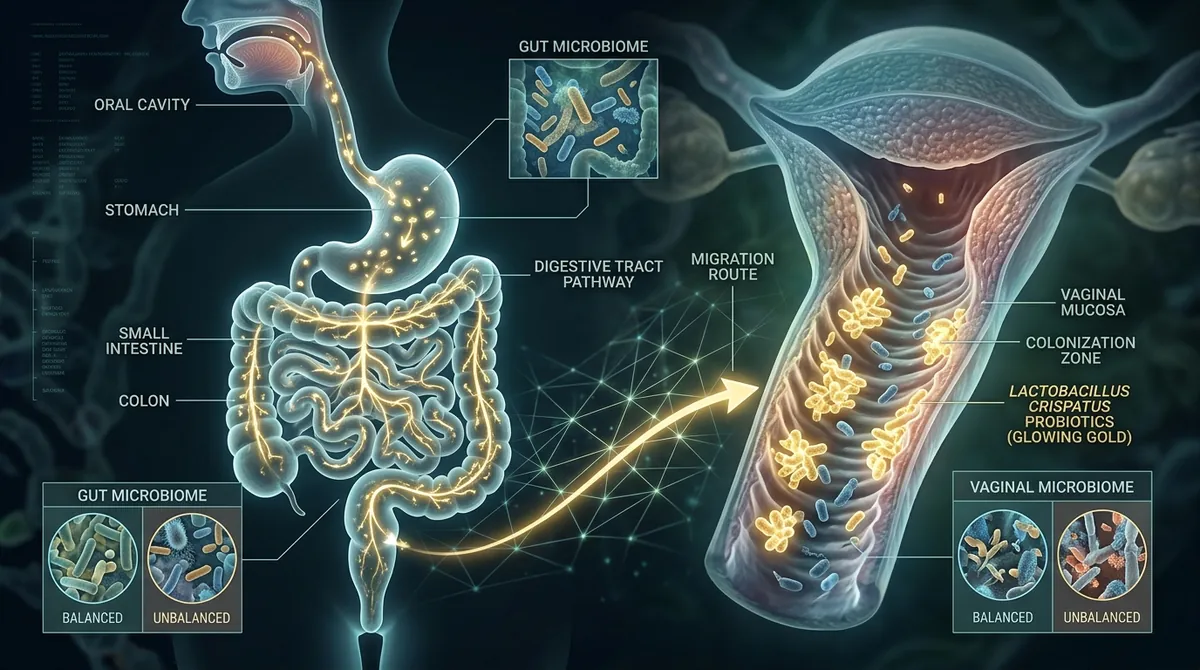
Over 60% of retail feminine probiotics make vague intimate claims while hiding behind generic gut bacterial cultures, unlisted strain codes, or yeast-feeding cane sugar syrups.
Vaginal mucosal colonization requires specific human-native strains (L. crispatus, L. rhamnosus, L. reuteri, L. gasseri) capable of biosynthesizing D- and L-lactic acid. Generic gut cultures or spore probiotics do not survive the acidic vaginal pH or displace anaerobic Gardnerella vaginalis.
To avoid wasting $30–$50/month, inspect the 'Supplement Facts' panel for: 1) explicit strain identifiers (e.g. LA806), 2) at least 5 to 20 Billion viable CFUs through expiration, 3) 0g added sugar in chewable formats, and 4) shelf-stable moisture-barrier packaging.
Table of Contents
- ✓ Specific Strains: Look for L. crispatus, L. rhamnosus, or L. reuteri with a strain code (e.g., LA806).
- ✓ Sugar Count: In chewable gummies, ensure 0g added sugar so you don't feed Candida yeast.
- ✓ CFU Guarantee: Look for "viable at end of shelf life", not just "at time of manufacture."
- ✓ Biofilm Support: For chronic recurring odor, check for proteolytic enzymes (like standardized Bromelain).
- ✓ True Cost/Day: Divide bottle price by servings (aim for $1.00 – $1.45/day).
Walking down the supplement aisle at Target or scrolling through Amazon, virtually every feminine probiotic bottle features pastel branding, promises of “balance,” and claims of “odor control.”
Yet independent laboratory audits show that over half of trending feminine supplements fail to deliver viable strains or include unneeded sugars that actively undermine vaginal health.
To protect your wallet and your microbiome, here is the exact 5-step checklist our editorial board uses to evaluate supplement labels.
1. Strain Specificity: Genus, Species, and the “Strain Code”
Legitimate probiotic science is strain-specific. A complete label should always show three pieces of information:
  Lactobacillus      crispatus         LA806
[Genus] [Species] [Strain Code]- The Genus: Identifies the broad family (e.g., Lactobacillus).
- The Species: Identifies the biological type (e.g., crispatus).
- The Strain Code: Identifies the exact clinically tested organism (e.g., LA806 or GR-1).
The Red Flag: Proprietary Blends with No Strain Codes
If a label lists “Vaginal Probiotic Blend (500mg)” or simply “Lactobacillus acidophilus” without any alphanumeric code, the brand is likely using cheap generic bulk cultures without published clinical trial data.
2. The 4 Apex Strains of the Human Vaginal Canal
Your vagina is not your colon. While your gut benefits from hundreds of diverse bacterial species, a healthy vaginal microbiome has low diversity dominated by four specific Lactobacilli [PMID: 28005436]:
- Lactobacillus crispatus: The Gold Standard. Produces high concentrations of both D- and L-lactic acid, as well as hydrogen peroxide ($H_2O_2$) to suppress Gardnerella vaginalis.
- Lactobacillus rhamnosus: The Colonizer. Exceptional ability to survive stomach acid, migrate from the rectum across the perineum, and adhere to vaginal epithelial cells.
- Lactobacillus reuteri: The Antimicrobial Shield. Produces reuterin, a potent compound that inhibits anaerobic pathogens.
- Lactobacillus gasseri: The Mucosal Buffer. Frequently co-dominates with L. crispatus during hormonal fluctuations.
What to Avoid: If a “feminine” probiotic consists primarily of Bifidobacterium lactis or Bacillus coagulans with zero vaginal Lactobacilli, it is a gut probiotic rebranded in a pink bottle.
3. The 3-Gram Sugar Trap in Probiotic Gummies
Gummies have surged in popularity because they eliminate pill fatigue. However, you must flip the bottle over and check the “Total Sugars” row:
- Sugared Gummies (3g–5g per serving): Boiling gelatin or pectin with cane sugar or corn syrup feeds Candida albicans, creating the exact warm, sugary environment where yeast infections flourish [PMID: 29444983].
- Zero-Sugar Pectin Gummies (0g sugar): Modern formulations use plant pectin sweetened with monk fruit, stevia, or isomalt, providing the chewable convenience without feeding fungal pathogens.
4. CFU Count: Why 5–20 Billion Is the Sweet Spot
Many brands play the “CFU Numbers Game,” marketing 50 Billion or 100 Billion CFUs to justify a $50 price tag.
Clinical trials show that 5 Billion to 20 Billion CFUs of targeted Lactobacilli is the ideal clinical window for vaginal colonization. Dosages above 50 Billion CFU rarely provide superior vaginal colonization and frequently cause gastrointestinal cramping or gas during the first week.
Crucially, verify whether the label states “Viable Through Expiration” or merely “At Time of Manufacture.” Without desiccant-lined packaging or microencapsulation, cheap probiotics can lose up to 80% of their potency sitting on a retail shelf for three months.
5. Calculate the Real Cost Per Day
Supplement marketing often hides true costs by packaging bottles in 15-day or 20-day supplies:
$$\text{True Cost Per Day} = \frac{\text{Bottle Price}}{\text{Number of Daily Servings}}$$
- Under $0.80/day: Typically cheap generic cultures or sugared retail gummies with single spore strains.
- $1.00 – $1.45/day: The sweet spot for verified L. crispatus formulations in zero-sugar formats (e.g., FloraFresh or Happy V).
- Over $2.00/day: Often inflated brand markups unless backed by finished-product double-blind RCTs.
Related Label & Formulation Guides
- 5 Best Vaginal Probiotic Gummies of 2026 (OB-GYN Tested)
- Probiotic Gummies vs. Capsules: Which Form Is Right for You?
- Happy V vs. O Positiv URO: Real Label Analysis for BV & Odor
- Happy V vs. Lemme Purr: Ingredients & Evidence Compared
Clinical Protocol & Bioavailability Telemetry
Vaginal mucosal colonization requires specific human-native strains (L. crispatus, L. rhamnosus, L. reuteri, L. gasseri) capable of biosynthesizing D- and L-lactic acid. Generic gut cultures or spore probiotics do not survive the acidic vaginal pH or displace anaerobic Gardnerella vaginalis.
To avoid wasting $30–$50/month, inspect the 'Supplement Facts' panel for: 1) explicit strain identifiers (e.g. LA806), 2) at least 5 to 20 Billion viable CFUs through expiration, 3) 0g added sugar in chewable formats, and 4) shelf-stable moisture-barrier packaging.
Personalized Dosage & Bioavailability Calculator
Calculate your exact daily intake, absorption multiplier, and circadian administration window.
Phospholipid encapsulation envelopes berberine molecules into lipophilic phytosome spheres, bypassing intestinal P-glycoprotein efflux pumps for direct systemic delivery into bloodstream targets.
5 Best Vaginal Probiotic Gummies of 2026 (OB-GYN Tested)
Compare FloraFresh vs Lemme Purr vs O Positiv URO for zero sugar and biofilm disruption.
- PMID: 32402161(New England Journal of Medicine, 2020)
- PMID: 16697231(Microbes and Infection, 2006)
- PMID: 16260520(Obstetrics & Gynecology, 2005)
Frequently Asked Medical Questions
Which specific probiotic strains should I look for on a vaginal health label?
Look for indigenous human vaginal species: Lactobacillus crispatus, Lactobacillus rhamnosus, Lactobacillus reuteri, and Lactobacillus gasseri. Always check for a specific strain designation code (such as LA806 or GR-1) next to the genus and species name.
Does a higher CFU count (like 50 Billion or 100 Billion) mean the probiotic is better?
No. A formula with 5 Billion CFU of verified, acid-resistant Lactobacillus crispatus will outperform 100 Billion CFU of generic gut Bifidobacteria for vaginal pH restoration. Strain relevance and viability to expiration matter far more than raw CFU numbers.
Why do some probiotic gummies have 3 grams of sugar on the label?
Many commercial gummies use gelatin or pectin matrices boiled with cane sugar and tapioca syrup for candy-like flavor. However, women susceptible to yeast infections should avoid sugared gummies because simple sugars can promote Candida albicans proliferation.
Related Clinical Protocols
Boric Acid vs. Probiotics for BV and Yeast: The Dangerous Myth of the Chemical Reset
A clinical comparison of Boric Acid suppositories vs oral targeted probiotics for recurrent BV and yeast—examining mucosal ulceration, recurrence rates, and lasting eubiosis.
Can URO Probiotics Cause Spotting or Bladder Pain? Side Effects Explained
Experiencing unexpected mid-cycle spotting, delayed periods, or UTI-like bladder urgency after starting O Positiv URO probiotics? OB/GYN analysis of XOS prebiotics and the estrobolome.
Can You Take Vaginal Probiotics While on Antibiotics? (Yes, Follow the 2-Hour Rule)
Yes, you should take vaginal probiotics during antibiotics, but never at the exact same hour. Follow the 2-hour spacing rule to prevent secondary yeast infections.