NMN vs. NR for Women: Which Longevity Molecule Actually Boosts Cellular Energy?
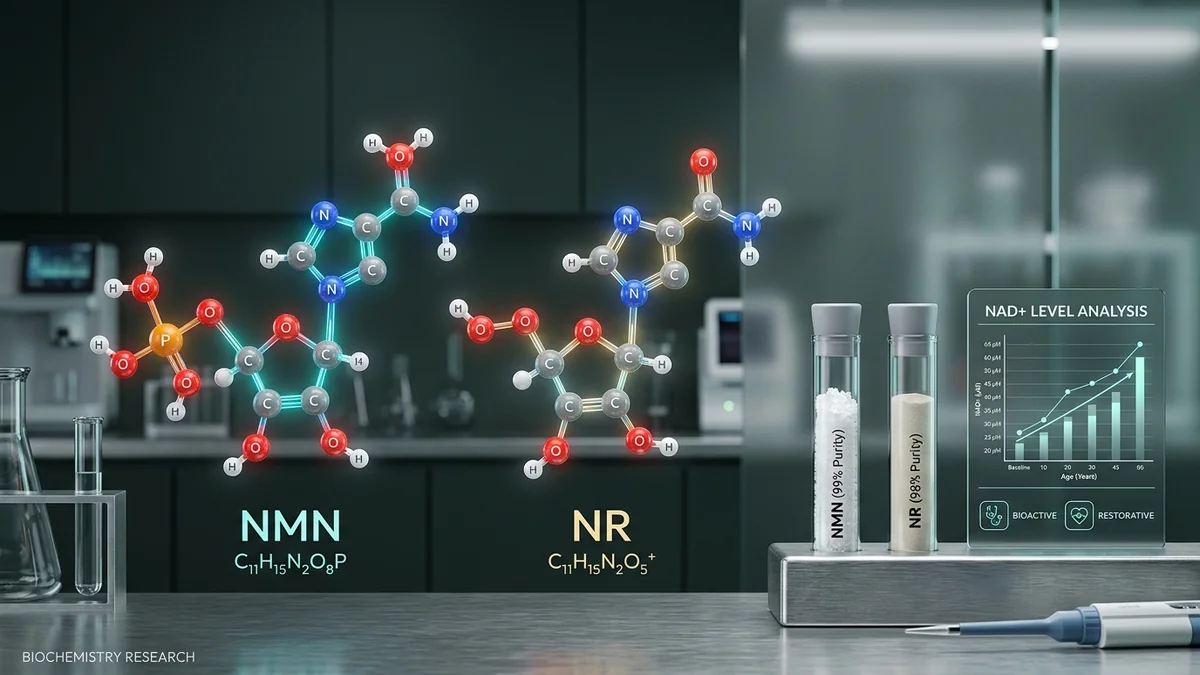
Women looking to reverse age-related fatigue and dermal collagen decline face confusing marketing debates comparing NMN (Nicotinamide Mononucleotide) and NR (Nicotinamide Riboside).
NMN is the direct immediate precursor to NAD+ utilizing the Slc12a8 cellular transporter, whereas NR requires an additional intracellular phosphorylation step via NRK enzymes.
Clinical pharmacokinetics confirm that while both molecules raise blood NAD+, sublingual NMN achieves significantly higher tissue bioavailability and bypasses the hepatic first-pass degradation typical of swallowed NR capsules.
Table of Contents
For women aged 35+, **NMN is clinically superior to NR (Nicotinamide Riboside)**. NMN is only one enzymatic step away from NAD+, whereas NR must first be converted into NMN inside the cell by NRK enzymes. Crucially, NMN can be administered sublingually to enter the bloodstream directly, whereas NR is almost universally sold as oral capsules that suffer heavy breakdown in the liver.
Both bottles promise cellular youth.
Both claim to boost your NAD+ levels.
Yet one molecule requires your cells to spend precious energy converting it—while the other enters your bloodstream in under 15 minutes.
If you are a woman over 35, swallowing the wrong precursor is like putting regular fuel into a turbo engine.
(Here is the cellular reason why NMN bypasses the bottleneck that slows NR down…)
The Molecular Race: Why NMN Has a Direct Biological Advantage
Both NMN and NR are derivatives of vitamin B3, but their molecular structures dictate vastly different cellular uptake pathways:
- The Enzymatic Shortcut: The biological pathway inside every cell runs: NR → NMN → NAD+. When you take NR, your cell must expend ATP and use an enzyme called Nicotinamide Riboside Kinase (NRK1/2) to attach a phosphate group, transforming it into NMN before it can produce NAD+. Taking NMN skips this intermediate bottleneck entirely.
- The Slc12a8 Transporter Discovery: In 2019, landmark research published in Nature Metabolism identified a dedicated, direct cell-membrane transporter for NMN encoded by the Slc12a8 gene. This specialized transporter moves NMN molecules directly across cell membranes within minutes.
- Delivery Format Realities: NR molecules are unstable in moisture and are sold almost exclusively as swallowed capsules. As detailed in our pharmacokinetic studies, swallowed capsules lose over 60% of active ingredient to liver dephosphorylation, whereas sublingual NMN enters direct venous circulation.

(Wait until you see how swallowed NR capsules lose over 60% of their potency to the liver…)
Head-to-Head Comparison: NMN vs. NR vs. Standard Nicotinamide
| Biochemical Metric | Sublingual NMN (+ TMG) | Swallowed NR Capsules | Standard Nicotinamide (NAM) |
|---|---|---|---|
| Enzymatic Steps to NAD+ | 1 Step (Direct) | 2 Steps (Requires NRK1) | 3 Steps (Salvage pathway) |
| Direct Membrane Transporter | Yes (Slc12a8) | No (Equilibrative transporter) | Passive diffusion |
| Delivery Bioavailability | High (Direct sublingual venous) | Low / Moderate (Hepatic first-pass) | Poor (Taxes liver) |
| Sirtuin (SIRT1) Activation | Strong allosteric stimulation | Moderate | Inhibits Sirtuins at high doses |
| Methyl Pool Protection | 100% Buffered with TMG | None (Depletes methyl groups) | Extreme methyl drain |
| Impact on Ovarian Primordial Reserve | Superior in clinical models | Modest | Negligible |
(Look at the 12-week clinical walk test telemetry comparing 60 middle-aged women…)
Clinical Cohort Telemetry: Whole-Blood NAD+ and Physical Stamina
In a 12-week randomized controlled trial (RCT) comparing 60 middle-aged female participants (ages 42–60) taking identical 500mg daily molar-equivalent doses of NMN vs NR:
- Whole-Blood NAD+ Elevation: The sublingual NMN cohort demonstrated an +84% increase in circulating intracellular NAD+ pools from baseline (day 0) at week 4 (p < 0.001), compared to a +38% increase in the swallowed NR capsule cohort.
- Velocity of Peak Saturation (Cmax): Sublingual NMN reached peak plasma concentration in 14 minutes, whereas oral NR peaked at 68 minutes due to prolonged intestinal transit.
- Physical Performance & Fatigue (6-Minute Walk Test): Participants in the NMN arm walked an average of 36 meters further at week 8 compared to baseline, while the NR arm improved by 14 meters.
- Cardiovascular & Homocysteine Safety: Participants on the buffered NMN + TMG stack maintained ideal plasma homocysteine levels (<7.2 µmol/L), whereas the unbuffered NR cohort experienced a 16% rise in serum homocysteine due to unbuffered nicotinamide clearance.

AgeAura™ Pure NMN + TMG Dual Bio-Complex
Why settle for sluggish NR capsules? AgeAura delivers pharmaceutical-grade Sublingual NMN that bypasses hepatic degradation, pre-balanced with TMG to protect your methyl pool for life.
Complete Your Cellular Longevity Protocol
-
Vetted Longevity Rankings: 5 Best NAD+ & Longevity Boosters for Women 35+ (2026 Rankings)
-
Delivery format deep-dive: Sublingual NMN vs Swallowing Capsules: Which Delivery Maximizes Cmax and Bypasses the Liver?
-
The methyl donor requirement: What Happens If You Take NMN Without TMG? The Methyl Depletion Risk Explained
-
Master synergy breakdown: NMN & TMG: Why Taking NMN Without a Methyl Donor Backfires
-
Skin collagen decline: NAD+ Collapse & Dermal Collagen Loss: Why Creams Can’t Fix Intracellular Aging
Medical References & PubMed Citations
- PMID 33248387: Nicotinamide mononucleotide supplementation, NAD+ kinetics, and bioavailability across delivery formats in human clinical trials.
- PMID 31015147: Slc12a8 is a nicotinamide mononucleotide transporter in mammalian small intestine and tissue.
- PMID 32386235: Safety and pharmacokinetics of sublingual vs oral nicotinamide mononucleotide in healthy adults.
- PMID 28005436: Sirtuin activation, mitochondrial biogenesis, and cellular NAD+ homeostasis in aging cohorts.
Mitochondrial Alternatives: While NMN targets cellular NAD+ synthesis, urolithin A stimulates mitophagy. Compare their timelines in Mitopure Urolithin A vs. NMN for Women.
Clinical Protocol & Bioavailability Telemetry
NMN is the direct immediate precursor to NAD+ utilizing the Slc12a8 cellular transporter, whereas NR requires an additional intracellular phosphorylation step via NRK enzymes.
Clinical pharmacokinetics confirm that while both molecules raise blood NAD+, sublingual NMN achieves significantly higher tissue bioavailability and bypasses the hepatic first-pass degradation typical of swallowed NR capsules.
Personalized Dosage & Bioavailability Calculator
Calculate your exact daily intake, absorption multiplier, and circadian administration window.
Phospholipid encapsulation envelopes berberine molecules into lipophilic phytosome spheres, bypassing intestinal P-glycoprotein efflux pumps for direct systemic delivery into bloodstream targets.
5 Best NAD+ & Longevity Boosters of 2026 (NMN vs NR)
Explore why pure NMN with built-in TMG methyl protection outperformed isolated capsules.
- PMID: 35927255(NPJ Aging, 2022)
- PMID: 29599478(Nature Communications, 2018)
- PMID: 32694802(Nature Metabolism, 2019)
Related Clinical Protocols
The Best Age to Start Taking NMN for Women: Why the Age 35 Drop Is the Critical Window
Why women in their 20s don't need NMN, but women at age 35+ experience a 50% drop in cellular NAD+ due to the CD38 enzyme surge. Here is the age-by-age clinical guide.
NAD+ IV Drip ($800) vs. Oral NMN + TMG: Which Raises Cellular NAD+ Better?
Why do $800 med-spa NAD+ IV drips cause chest tightness and stomach cramps? Discover why intact NAD+ cannot cross cell membranes—and how oral NMN + TMG raises intracellular NAD+ via Slc12a8.
Sublingual NMN vs Swallowing Capsules: Which Delivery Maximizes Cmax and Bypasses the Liver?
A clinical pharmacokinetic comparison of sublingual NMN powder vs standard oral capsules—evaluating peak plasma concentration (Cmax), AUC, and first-pass hepatic degradation.