The Cellular Longevity Guide for Women 35+: NMN, NR & Mitopure Compared (2026)
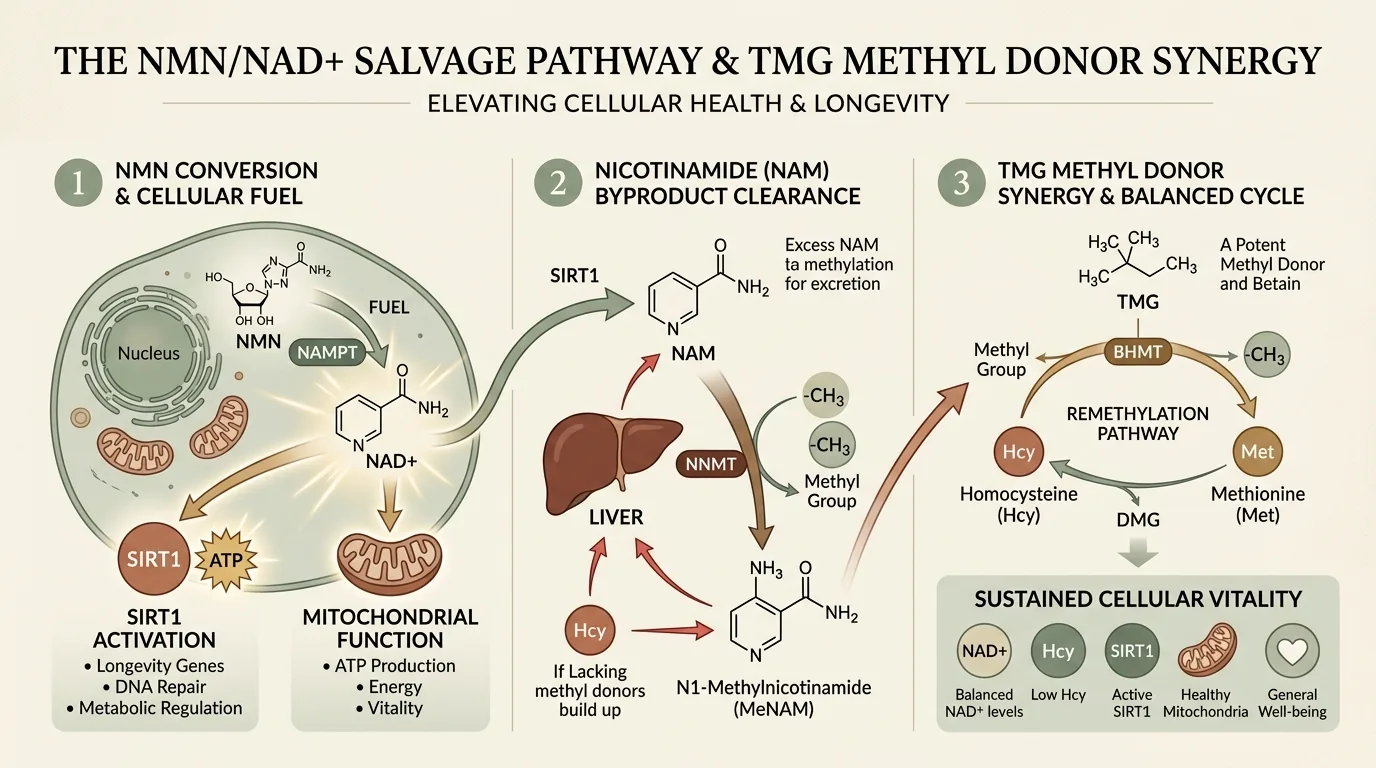
Table of Contents
You can exercise daily, eat clean organic food, and sleep eight hours—yet after age 38, your cells struggle to produce the same physical energy you took for granted in your twenties. Behind the marketing buzzwords of Silicon Valley longevity clinics, the biological cause is straightforward: by your 40th birthday, intracellular levels of Nicotinamide Adenine Dinucleotide ($NAD^+$) have plummeted by over 50%.
Find Your Exact Cellular Longevity Protocol
Skip the generic marketing hype and jump directly to unbiased head-to-head comparisons and laboratory assays:
Tru Niagen vs. Elysium Basis vs. Pure NMN
Compare patented Nicotinamide Riboside (NR) capsules against enteric NMN and investigate Elysium's LDL cholesterol data.
Timeline Mitopure (Urolithin A) vs. NMN
Compare cellular NAD+ coenzyme fuel against mitochondrial recycling (mitophagy) for endurance and muscular strength.
The TMG Methyl Group Buffer
Why high-dose NMN or NR without Trimethylglycine can drain hepatic SAMe pools and elevate homocysteine levels.
Sublingual vs. Enteric Swallowed Capsules
How gastric stomach acids degrade unprotected NMN into ordinary niacinamide, and how enteric delivery preserves potency.
The Cellular Energy Crisis: Why NAD+ Collapses by 50% at Age 40
$NAD^+$ is not a luxury wellness supplement; it is an essential coenzyme present in every living cell. It serves two distinct functions:
- Oxidative Phosphorylation: Transferring electrons in mitochondrial complexes I and III to generate ATP (adenosine triphosphate).
- DNA Repair & Sirtuins: Serving as the obligate substrate for PARP1 (which repairs double-strand DNA breaks) and SIRT1–SIRT7 (sirtuin enzymes that regulate epigenetic longevity and mitochondrial biogenesis).
As we accumulate cellular wear and tear, chronic activation of the inflammatory enzyme CD38 consumes vast quantities of $NAD^+$. By the time a woman enters perimenopause, her $NAD^+$ recycling machinery cannot keep pace with consumption, resulting in progressive mitochondrial decline, cognitive fatigue, and dermal collagen loss.
The NMN vs. NR Dilemma: Cellular Transport & The Slc12a8 Pathway
The longevity industry has historically debated between two precursors: Nicotinamide Mononucleotide (NMN) and Nicotinamide Riboside (NR).
| Comparison Parameter | Nicotinamide Riboside (NR) | 🏆 Pure NMN + TMG |
|---|---|---|
| Molecular Structure | Smaller molecule (no phosphate group) | Direct precursor (has phosphate attached) |
| Cellular Transporter | Requires ENT transporters + NRK1 phosphorylation | Direct, dedicated uptake via Slc12a8 channel |
| Human Trial Muscle Data | Elevates blood NAD+, modest motor improvements [PMID: 29599478] | Clinically improves muscle insulin sensitivity [PMID: 35927255] |
| Methyl Donor Buffering | ❌ None (Unbuffered in Tru Niagen / Elysium) | ✅ Formulated with Trimethylglycine (TMG) |
| Typical Retail Cost | $45 – $65 / month | From $1.39 / day (Multi-bottle protocol) |
The Methyl Group Trap: Why Taking NAD+ Precursors Without TMG Backfires
When you consume high doses (500mg to 1,000mg) of NMN or NR, your cells convert it into NAD+. But after NAD+ is consumed by sirtuins or CD38, it breaks down into nicotinamide (NAM).
Excess NAM is toxic if allowed to accumulate. To eliminate it, your liver attaches a methyl group via NNMT to create N-methylnicotinamide, which is flushed in urine. If your supplement does not contain a methyl donor like Trimethylglycine (TMG), your liver pulls methyl groups from your body's SAMe reserves—leading to methyl donor exhaustion, elevated homocysteine, and afternoon brain fog.
Mitophagy Breakthrough: Urolithin A (Mitopure) vs. NAD+ Precursors
While NAD+ precursors like NMN provide fuel for existing mitochondria, they do not resolve the problem of damaged, senescent mitochondria cluttering cellular space.
This is where Urolithin A (Mitopure) has emerged as a complementary longevity pillar. Derived from the microbial transformation of pomegranate ellagitannins, Urolithin A stimulates mitophagy—the selective recycling of dysfunctional mitochondria into healthy cellular components [PMID: 32694802]. In randomized human trials of middle-aged adults, Urolithin A improved leg muscle strength and VO2 max without affecting hormonal pathways.
AgeAura™ Pure NMN + TMG Cellular Protocol
The only tested formulation combining 500mg of ultra-pure β-NMN with 250mg of Trimethylglycine (TMG) in an enteric-coated delivery capsule to bypass stomach acid degradation while shielding hepatic methyl reserves.
The Complete Cellular Longevity Research Cluster
Explore our independent investigative reports on NAD+ bioavailability, clinical human trials, and sirtuin biology:
Frequently Asked Questions on NAD+ & Aging
Between NMN and Nicotinamide Riboside (NR), which is clinically superior for women?
Clinical pharmacology demonstrates that NMN has a dedicated, direct cellular transporter (Slc12a8), allowing rapid uptake into cells. In contrast, swallowed NR must first undergo intracellular phosphorylation to become NMN before converting into NAD+. Furthermore, NMN trials show superior improvements in muscle insulin sensitivity in postmenopausal women [PMID: 35927255].
Why must you take Trimethylglycine (TMG) when supplementing with NMN or NR?
When your body metabolizes NMN or NR, excess nicotinamide is methylated by the enzyme NNMT (nicotinamide N-methyltransferase) and excreted in urine. This enzymatic process drains your body's S-adenosylmethionine (SAMe) methyl pools, which can elevate homocysteine and cause hepatic fatigue. TMG supplies three active methyl groups, preventing methyl exhaustion.
How does Urolithin A (Mitopure) differ from NMN and NR?
NMN and NR replenish cellular NAD+ coenzymes, providing fuel for mitochondria and sirtuin longevity enzymes. Urolithin A does not raise NAD+; instead, it stimulates mitophagy—the cellular recycling process that cleans out damaged, dysfunctional mitochondria [PMID: 32694802]. For optimal cellular health, many longevity clinicians combine both.
Frequently Asked Medical Questions
Between NMN and Nicotinamide Riboside (NR), which is clinically superior for women?
Clinical pharmacology demonstrates that NMN has a dedicated, direct cellular transporter (Slc12a8), allowing rapid uptake into cells. In contrast, swallowed NR must first undergo intracellular phosphorylation to become NMN before converting into NAD+. Furthermore, NMN trials show superior improvements in muscle insulin sensitivity in postmenopausal women [PMID: 35927255].
Why must you take Trimethylglycine (TMG) when supplementing with NMN or NR?
When your body metabolizes NMN or NR, excess nicotinamide is methylated by the enzyme NNMT (nicotinamide N-methyltransferase) and excreted in urine. This enzymatic process drains your body's S-adenosylmethionine (SAMe) methyl pools, which can elevate homocysteine and cause hepatic fatigue. TMG supplies three active methyl groups, preventing methyl exhaustion.
How does Urolithin A (Mitopure) differ from NMN and NR?
NMN and NR replenish cellular NAD+ coenzymes, providing fuel for mitochondria and sirtuin longevity enzymes. Urolithin A does not raise NAD+; instead, it stimulates mitophagy—the cellular recycling process that cleans out damaged, dysfunctional mitochondria [PMID: 32694802]. For optimal cellular health, many longevity clinicians combine both.
Related Clinical Protocols
NAD+ IV Drip ($800) vs. Oral NMN + TMG: Which Raises Cellular NAD+ Better?
Why do $800 med-spa NAD+ IV drips cause chest tightness and stomach cramps? Discover why intact NAD+ cannot cross cell membranes—and how oral NMN + TMG raises intracellular NAD+ via Slc12a8.
Adrenal Cocktail vs. Himalayan Shilajit Resin: Which Rebuilds Cellular Minerals Faster?
TikTok's viral Adrenal Cocktail promises hormone balance, but does the sugar spike cortisol? Compare orange juice and sea salt vs high-altitude Shilajit resin.
Why You're Tired But Wired at Night: The Adrenal-Mineral Depletion Connection
Chronic stress and caffeine quietly flush ionic minerals from your body daily, leaving your nervous system too exhausted to sleep but too dysregulated to rest. Here's the science.